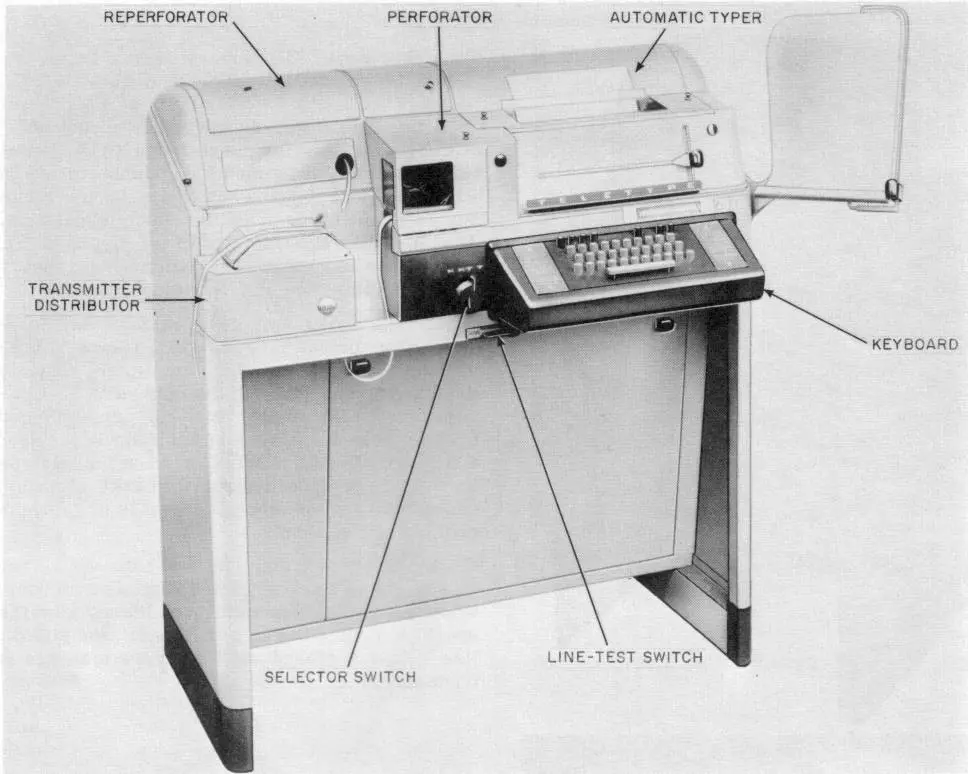
The Mod-28 ASR
The Teletype Corporation Mod-28 was the workhorse teletype of its era. Built like a tank, it seemed perfectly happy whether it was sitting in an air-conditioned communications center or taking rolls on a tin can Destroyer in the NORLANT. The thing had approximately a brazillion moving parts. Looking inside one for the first time could make a competent auto mechanic queasy…
I worked with the Mod-28 ASR (Automatic Send/Receive), equipped with a five-level paper tape punch. As you typed, characters appeared both on the paper copy and on the paper tape over the punched out telegraphic code pattern.
The tape wasn't just a record of what you'd typed — it was part of the workflow. Different report types had different message headers, different priorities, and different audiences. Naval reporting had one format. Maritime reporting had another. Aviation reporting had yet another. To save time, we'd often prepare the standard headers in advance and punch them onto paper tape. And we’d also save the transmitted reports’ tapes for the record.
Report header paper tapes would be butterfly-wrapped over thumb and pinky into a neat loop, annotated, and hung on a line strung over the reporter desk, ready for immediate use. For bigger missions with a large AOR, there could be a couple of dozen loops hanging up there. When reportable activity started occurring, the reporter would grab the appropriate header, run it, and be ready to start writing the report as the activity unfolded. A second set of eyes to gut-check, q/c, and Zag it out to the Community. And on the second midwatch of a 2/2/2/80 schedule, you were grateful for that second set of eyeballs.
Typos…. Typos were a different matter. The Mod-28 had no interest whatsoever in helping you correct your mistakes. If you punched a bad character into the tape, you had to back up to the error and null out the offending character manually. There was no Backspace key riding to the rescue. Worse, if you realized you had made an erroneous entry — the wrong ship name, the wrong callsign, whatever — you’d have to cut the tape and physically splice in the correction, and those splices tended to snag on the pin reader on the paper-tape head.
We used the machines to produce everything from short-suspense tactical reports to lengthy multi-page product reports. A good operator could make the process look easy. It wasn't. The Model 28 demanded patience, attention, and a willingness to become acquainted with a remarkable amount of machinery.
For all that, I loved punching tapes out. So loud, complicated, heavy, tactile, and endlessly fascinating. How many typewriters have you used that needed a tachometer and an oil can? When properly adjusted, they would run all day without complaint, producing message traffic for operators who trusted them completely.