A MUSEUM OF LISTENING
SpecialSignals
Vintage radios, signals, stories, and the rooms where listening happened.
THE COLLECTION
ROOM AUDIO — PENDING
Historical audio for this room is still being curated and verified.
RECORDING SOURCE / PROVENANCE ↗
THE COLLECTION
Catalog
Select a receiver to go directly to its room scene.
OTHER GEAR
Beyond the Receivers
Not every piece in the collection is a radio. Other interesting gear includes vintage speakers, a vacuum tube tester, a Morse trainer (and my ear is still pretty good!), a multimode signal processor, etc. More to follow in this section.
ABOUT THIS GEAR
SPECIFICATIONS
ESSENTIAL LIBRARY
Essential Library
Every serious collector needs a serious library. These are the volumes that shaped how I understand the signals, the machines, and the history they carried.
ESSENTIAL LIBRARY
Select a book to open its card.
MERCHANDISE
Merchandise
An Assortment of Procurable Interesting Items.
ABOUT THIS ITEM
COLLECTING
The Hunt
Almost without fail, when someone views my radios, they'll ask: “Where did you find these?” My first radio — the Hallicrafters SX-110 — came via EstateSales.net, which led me to an estate sale in nearby North Augusta, SC. I didn't know what to expect to pay, as prices aren't listed. I didn't know if I was paying too much or getting a steal. But the radio was clean, plugged in, and playing a Bulldogs game. I switched it to CW, found Morse on the first try, and that was that. Here is my list of go-to resources, in order of success.
ABOUT THIS RESOURCE
ABOUT THE COLLECTOR
Forty-four Years in the Shadows
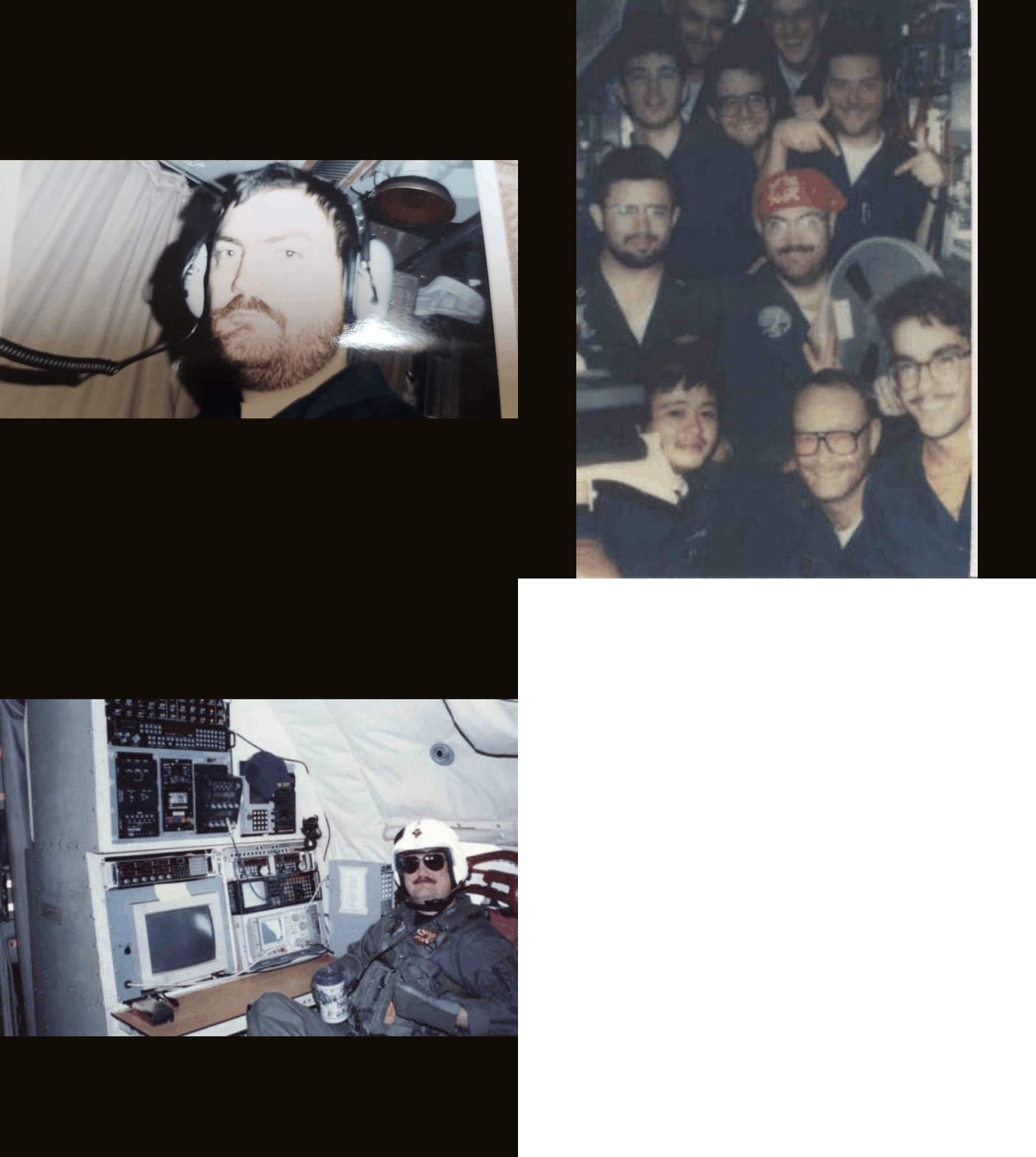
On Station
“An Analog Man
Caught in a Digital Age
Lost in the Ether...”
Twenty years in the United States Navy. Twenty-four years in the Intelligence Community. A career spent listening for signals that mattered — Cold War intercepts, special signals, the quiet transmissions that shaped history before most people knew history was being shaped.
Retirement brought a different kind of listening. Vintage tube radios — the receivers that ordinary Americans gathered around while the world changed beneath them. A Zenith console in a Maine cottage the year of the Hurricane of '38. A Hallicrafters in a signals room the night Pearl Harbor changed everything. A Trans-Oceanic on a diplomat's desk during the Cuban Missile Crisis.
Each radio in this collection came with a story. Some I know. Some I'm still working out. All of them are worth hearing.
FEEDBACK & QUESTIONS ARE ALWAYS WELCOMED
Use this form to reach the collector. Your email address will only be used to reply to your message.
ABOUT THIS SITE
A Museum of Listening
“To preserve not only the radios,
but something of the world people once heard through them.”
Special Signals — A Museum of Listening is an independent, personally maintained virtual museum devoted to the history of radio, shortwave listening, communications, and the signals that once filled the airwaves.
The receivers and related equipment displayed here are not a virtual collection. They are real, personally owned historical artifacts — acquired, preserved, restored where appropriate, researched, and photographed for this project. The website is the public exhibition space for that physical collection.
PUTTING THE RADIOS BACK IN THEIR WORLD
Rather than display each receiver against a blank background, Special Signals places it in an interpretive room scene appropriate to its time and use: a family parlor, wartime home, railroad car, listening post, ham shack, Cold War monitoring position, college dormitory, and many others.
These scenes are historical interpretations, not representations of specific surviving rooms. Period furnishings, documents, advertisements, newspapers, photographs, books, and other details are used to provide context and help answer a simple question:
What would it have been like to encounter this radio when it was part of everyday life?
A MUSEUM OF LISTENING
Radio history is unusual because much of what made these objects important cannot be seen.
The broadcasts mattered. The voices mattered. The music, news, Morse code, radioteletype, interval signals, interference and distant stations fading in and out of the noise were the reason these machines existed.
Where suitable recordings can be responsibly sourced, Special Signals therefore pairs its room scenes with period or representative audio. The objective is not simply to show visitors an old radio, but to restore something of the experience of listening through it.
Audio sources and usage information are researched and documented as part of the museum's continuing provenance work.
MORE THAN A DISPLAY
Special Signals is intended to be explored, not simply viewed.
Interactive exhibits give visitors opportunities to experience some of the technologies and skills behind the collection. The Teletype Operations exhibit recreates elements of a radioteletype intercept position, allowing visitors to work with historic and live RTTY signals, adjust baud rate and spectrum controls, and see how a properly tuned signal resolves into readable traffic.
The Morse Trainer introduces visitors to the communications method that connected ships, aircraft, military stations, amateur operators and commercial services for generations. Rather than merely describing Morse code, the exhibit lets visitors hear it, practice it and begin learning to recognize it.
The Reel-to-Reel exhibit provides another window into the way signals and broadcasts were once captured, preserved and replayed before digital recording became commonplace.
The developing room-scene audio collection extends that idea throughout the museum. Where appropriate historical recordings can be responsibly used, visitors will be able to enter a period room, examine its radio and furnishings, and hear something representative of what a listener in that place and time might actually have encountered on the dial.
And visitors who explore carefully may discover a few Easter eggs along the way. Some are tucked into the room scenes; others are hidden within the interactive exhibits. They reward curiosity, close observation and experimentation — very much in the spirit of radio itself. We won't say where they are. Finding them is part of the museum experience.
Together, these exhibits — including a few things we deliberately don't point out — serve the larger purpose of Special Signals: to make communications history experiential rather than static.
AN INDEPENDENT PROJECT
Special Signals is a personal historical and educational project. It is personally funded by its creator, including the acquisition and restoration of the collection and the costs of developing, hosting, researching, and maintaining the website. There is no admission charge, subscription, membership fee, or paywall.
The site does not claim institutional accreditation, tax-exempt status, or affiliation with a museum organization. The term museum describes the purpose of the project: to collect, preserve, research, interpret, and publicly exhibit historical material for education, reflection, and enjoyment.
Some sections contain clearly identified Amazon and eBay affiliate links. If a visitor chooses to make a qualifying purchase through one of those links, a small commission may be received at no additional cost to the visitor. To date, those links have generated only nominal revenue and do not come close to covering the costs of operating the project.
Special Signals exists for one purpose: to preserve not only the radios, but something of the world people once heard through them.
OPERATIONS
Long shifts spinning through the ether, punctuated by moments of sheer, adrenaline-fueled, in-front-of-the-headlines excitement. That’s life in Operations.
Rotate your device to landscape to enter the operator position.
SPECIAL SIGNALS · OPERATIONS
−SYNC+
1
2
3
4
5
POWER
CH 1 · SWEDISH NAVAL
POWER OFF
MORSE TRAINER
Train your ear, not your eyes.
Rotate your device to landscape to enter the training position.
INTERNATIONAL MORSE TRAINERSPECIAL SIGNALS · TRAINING
PHASE 1 · CHARACTER TRAININGREADY